

In Kampala, where waste and poverty remain pressing challenges, two Ugandan women are leading a quiet but impactful transformation.
Scovia N. Swabrah, Communications and Research Specialist at FINCA Uganda, and her colleague Justine Nabawanuka, a Marketing and Research Officer, are behind “Waste to Wealth,” a grassroots initiative funded by the 2024 Rupert Scofield Vision Fund. Their approach is simple yet transformative. They are turning urban waste into eco-friendly briquettes that fuel homes, cut emissions, and create livelihoods in Uganda’s low-income neighborhoods.
Their work began in underserved areas like Namasuba, Zana, Bwebajja and Namugongo, and will extend to similar settlements such as Bwaise, Kamwokya and Kawempe, where uncollected waste and dependence on charcoal or firewood are daily burdens. Here, the cost of living is high, but the cost to the environment is even higher.
According to a 2022 report by the National Environment Management Authority, Kampala alone produces over 2,500 tonnes of solid waste every day, with less than half of it collected formally.

Through this initiative, Scovia and Justine are advancing global efforts aligned with the United Nations Sustainable Development Goals, specifically Goal 13 on Climate Action and Goal 8 on Decent Work and Economic Growth. By reducing environmental degradation and creating environmentally friendly enterprises, “Waste to Wealth” is turning these global ambitions into grassroots realities.
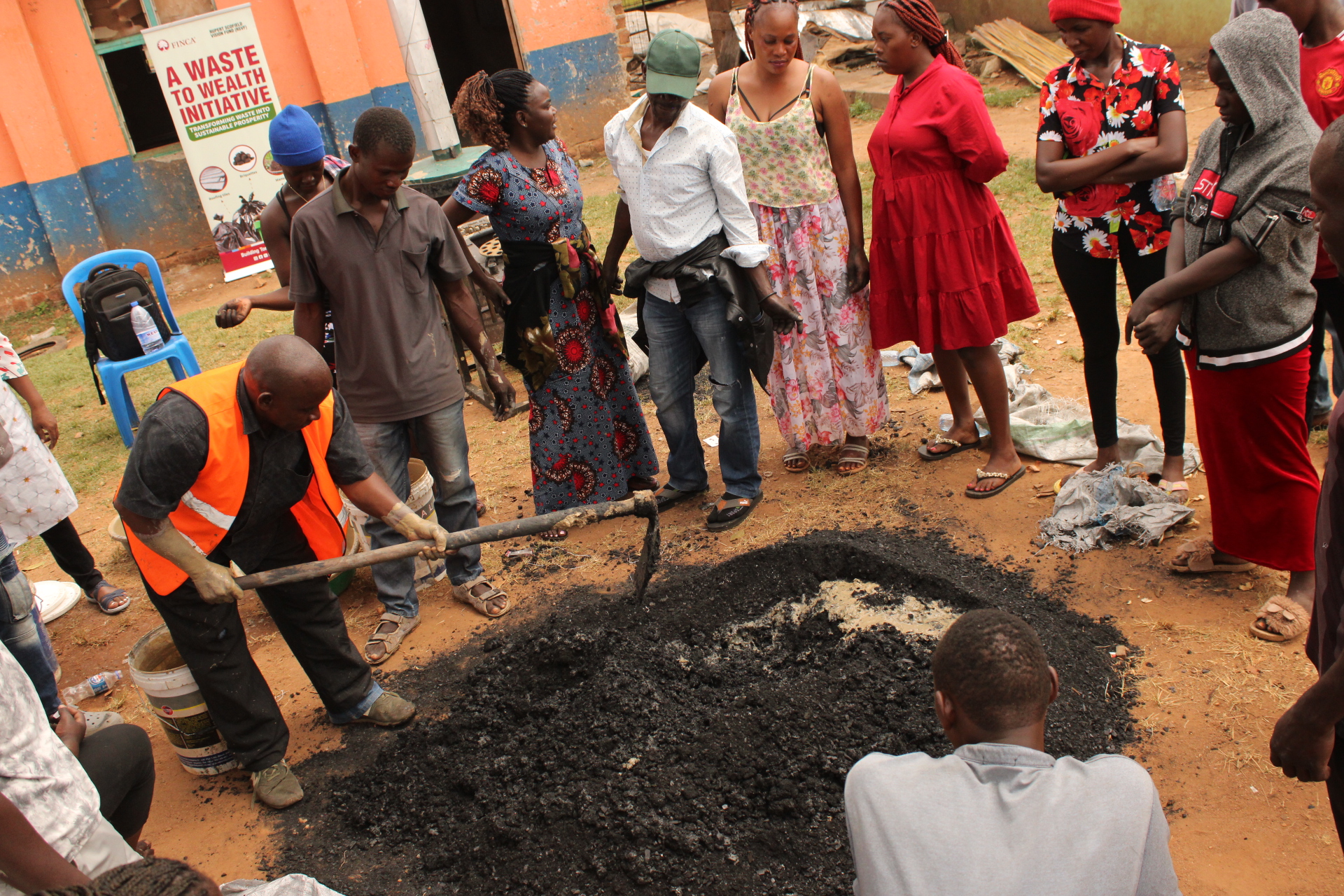
Scovia and Justine’s intervention focuses on training women and youth to convert banana peels, paper, and sawdust into clean-burning briquettes. These briquettes offer more than just an environmental solution—they are financially transformative. A 2023 study by Makerere University’s Department of Environmental Management found that households using briquettes cut their monthly fuel spending by up to 52%, while reducing indoor air pollution by more than 60%.
“Most families here spend an average of 120,000 shillings a month on charcoal. With briquettes, that drops to around 60,000,” says Justine. “But more importantly, we are changing how people see waste. It is no longer something to throw away but something to work with,” adds Justine.
In Namasuba, women who once faced daily income struggles now run small businesses selling briquettes. In Namugongo, partnerships with groups like the Equal Youth Empowerment Network have helped shift young people’s mindsets. Waste is no longer seen as a problem but as a resource. “Young people are realizing they do not have to wait for formal jobs,” says Scovia. “There is opportunity in every discarded piece of waste.”
By promoting recycling and alternative fuels, the Waste to Wealth initiative is addressing deeper issues like unemployment and environmental degradation from the ground up. Its success lies in its simplicity and community-led approach.
As Uganda moves toward its Vision 2040 and the National Development Plan Three, both of which emphasize sustainable urbanization and environmental protection, this initiative serves as timely proof of what works when communities take the lead.
In a city struggling with the weight of its own waste, these two women are showing that the future does not have to be buried in garbage. It can be shaped from it—one briquette, one saved tree, and one empowered household at a time.