
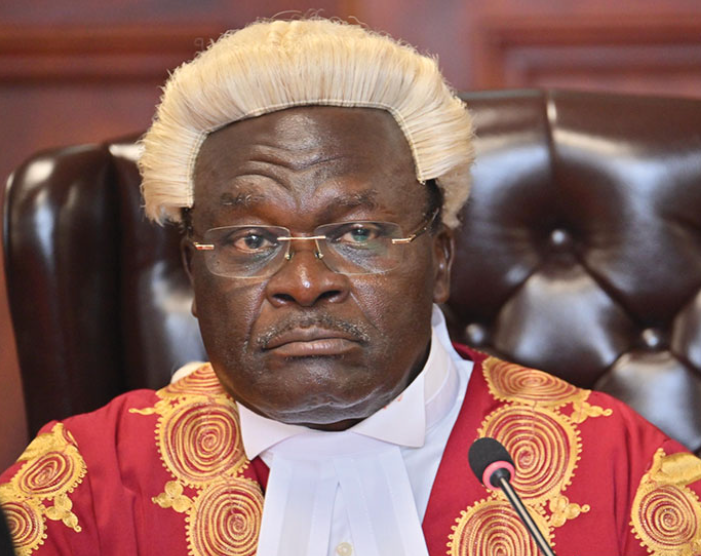
Chief Justice Alfonse Chigamoy Owiny-Dollo has officially retired from Uganda’s Judiciary after reaching the mandatory retirement age of 70, concluding a distinguished career spanning over four decades in law, conflict resolution, and public service.
Born on January 18, 1956, in what is now Agago District, northern Uganda, Owiny-Dollo stepped down at midnight on Sunday, January 18, 2026, in line with Article 144(1)(a) of the Constitution, which requires the Chief Justice, Deputy Chief Justice, and justices of the Supreme Court and Court of Appeal to vacate office upon turning 70.
On Monday, January 19, he formally handed over the office to his deputy, Dr. Flavian Zeija, in a ceremony at the Supreme Court boardroom.
Senior Judiciary officials described his five-year tenure as disciplined, reform-oriented, and collegial.

Owiny-Dollo’s judicial journey began after earning a Bachelor of Laws from Makerere University, a Diploma in Legal Practice from the Law Development Centre, a Master of Arts in Conflict Resolution from the University of Bradford, and advanced mediation training in Cape Town.
His early career included roles as legal counsel in late-1980s peace talks between the government and the Uganda People’s Democratic Movement, serving as a Constituent Assembly delegate to draft the 1995 Constitution, representing Agago County in Parliament (1996–2001), and as Minister of State for the Northern Uganda Reconstruction Programme.
He later advised South Sudanese Vice President Riek Machar in 2006–2008 LRA-government negotiations, including a notable meeting with Joseph Kony in the DRC.
Appointed to the High Court in 2008, elevated to the Court of Appeal in 2015, and named Deputy Chief Justice in 2017, he became Acting Chief Justice in June 2020 before President Yoweri Museveni appointed him the 13th Chief Justice in August 2020, succeeding Bart Magunda Katureebe.
As Chief Justice, he spearheaded the Judiciary Transformation Agenda (2020–2025), focusing on clearing case backlogs, enhancing access to justice, digitizing operations, and upgrading infrastructure.
He presided over high-profile matters, including the 2021 presidential election petition and rulings curbing military courts’ jurisdiction over civilians, while emphasizing judicial independence amid occasional criticisms of Bar-Bench relations.
In farewell remarks, Owiny-Dollo expressed fulfillment, noting reforms that strengthened technology, infrastructure, and institutional autonomy.
He plans to champion alternative dispute resolution in retirement.
The retirement leaves the Judiciary without a substantive Chief Justice, raising questions about transitions, especially with potential future election petitions looming.
Deputy Chief Justice Zeija currently acts in the role pending a new presidential appointment.