
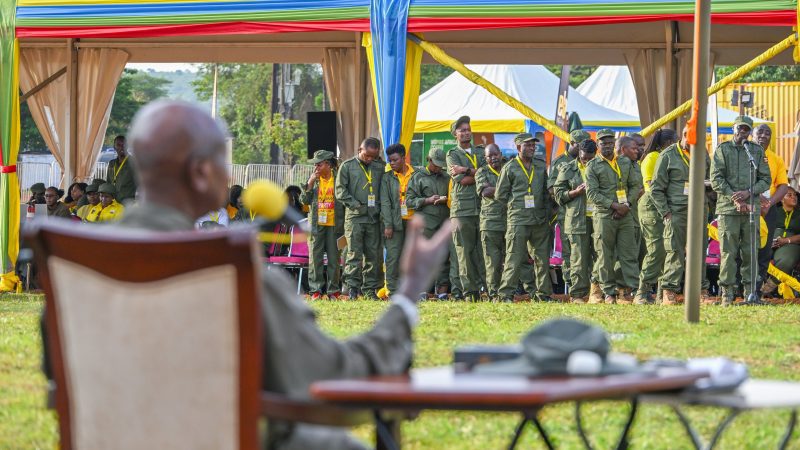
President Yoweri Kaguta Museveni has urged the Supreme Court to dismiss with costs a petition challenging his re-election in the 2026 presidential race, filed by Robert Kasibante of the National Peasants Party (NPP).
Museveni argues that the petition is legally flawed, lacks sufficient evidence, and fails to meet the required standards under Ugandan law.
Museveni’s formal response was submitted on Monday through his legal team at K&K Advocates, comprising Usaama Sebuufu and Anthony Bazira.
This follows Kasibante’s petition lodged on January 17—within the mandatory 10-day window after the January 15, 2026, general election—naming Museveni as the first respondent, the Electoral Commission as the second, and the Attorney General as the third.

Kasibante, who placed sixth among eight candidates with 33,440 votes (0.30% of the total), contests the Electoral Commission’s declaration of Museveni as the winner with 7,946,772 votes (71.65%).
He alleges the poll was undermined by extensive irregularities, including violence, voter bribery, intimidation, misuse of state resources, harassment of opposition figures, and systemic breaches of electoral laws.
He further claims the Electoral Commission lacked independence, operating under the influence of the incumbent and ruling party officials.
The official results placed National Unity Platform (NUP) leader Robert Kyagulanyi Ssentamu (Bobi Wine) second with 2,741,238 votes (24.72%), followed by Nathan Nandala Mafabi (209,039 votes), Gen. Gregory Mugisha Muntu (59,276 votes), Frank Bulira (45,959 votes), Mubarak Munyagwa (31,666 votes), and Kasibante himself.
Voter turnout stood at approximately 52.5%.
In his defense, Museveni denies nearly all allegations, admitting only those explicitly conceded. He asserts that the election complied fully with the Constitution, the Electoral Commission Act, and the Presidential Elections Act.
Any purported irregularities—denied outright—did not materially impact the outcome, he argues. Through an affidavit, Museveni swears he was lawfully elected for the 2026–2031 term, reflecting “the free will of the people of Uganda.”
He claims no knowledge of illegalities and affirms the Commission properly exercised its mandate.
On the Commission’s alleged lack of independence, Museveni rejects any personal or indirect influence, stating he neither directed nor consented to any improper control over the body.
Regarding claims of violence and intimidation involving the Uganda Police Force and Uganda People’s Defence Forces (UPDF), he maintains security measures were implemented solely to ensure a safe voting environment, with no partisan interference by UPDF personnel.
He describes the election atmosphere as peaceful overall. Museveni also dismisses accusations of voter bribery, including specific claims of Shs 3 billion distributed to mechanics in Kampala or inducements by musician Moses Ssali (Bebe Cool).
He denies abusing state resources, noting any government facilities used were standard for the presidential office and legally permitted.
Addressing technical issues with the voters’ register and biometric verification machines, Museveni defends the Commission’s processes as credible and lawful, with manual alternatives applied where needed to prevent disenfranchisement.
He insists polling stations were properly gazetted, counting and tallying occurred transparently in the presence of agents, and results were declared within the required 48 hours.
Museveni raises procedural objections, contending many claims are vague, lack specifics, or fall outside the Supreme Court’s jurisdiction under the Presidential Elections Act.
He argues remedies like result cancellation or broad audits are unavailable. His lawyer, Usaama Sebuufu, confirmed compliance with court directives.
The Electoral Commission and Attorney General have already submitted their responses.
An application for discovery is set for Wednesday, ahead of the full hearing.
This petition aligns with a pattern: since 2001, every Ugandan presidential election has faced Supreme Court challenges, including those by Dr. Kizza Besigye, Amama Mbabazi, and Bobi Wine in 2021.
In prior cases, the court noted irregularities but upheld results due to the stringent threshold for annulment—proof that flaws substantially affected the outcome.