



As Sudan’s war enters its third year, the conflict has evolved into one of the most complex and devastating crises in Africa marked not only by ground fighting between rival forces but by the growing dominance of armed drones, foreign political interests, and regional power calculations. Nowhere is the impact more visible than in Darfur and Kordofan, where civilians increasingly live under the constant threat of aerial strikes.
Since fighting erupted in April 2023 between the Sudanese Armed Forces (SAF) and the Rapid Support Forces (RSF), civilian casualties have risen at an alarming rate. While much attention has focused on displacement, hunger, and militia violence, the expanding use of drone warfare has introduced a new, more invisible form of terror one that strikes from above, often without warning.
In towns and villages across Darfur, residents have learned to fear a sound they once ignored: the low mechanical hum of drones overhead. That noise now signals possible death.
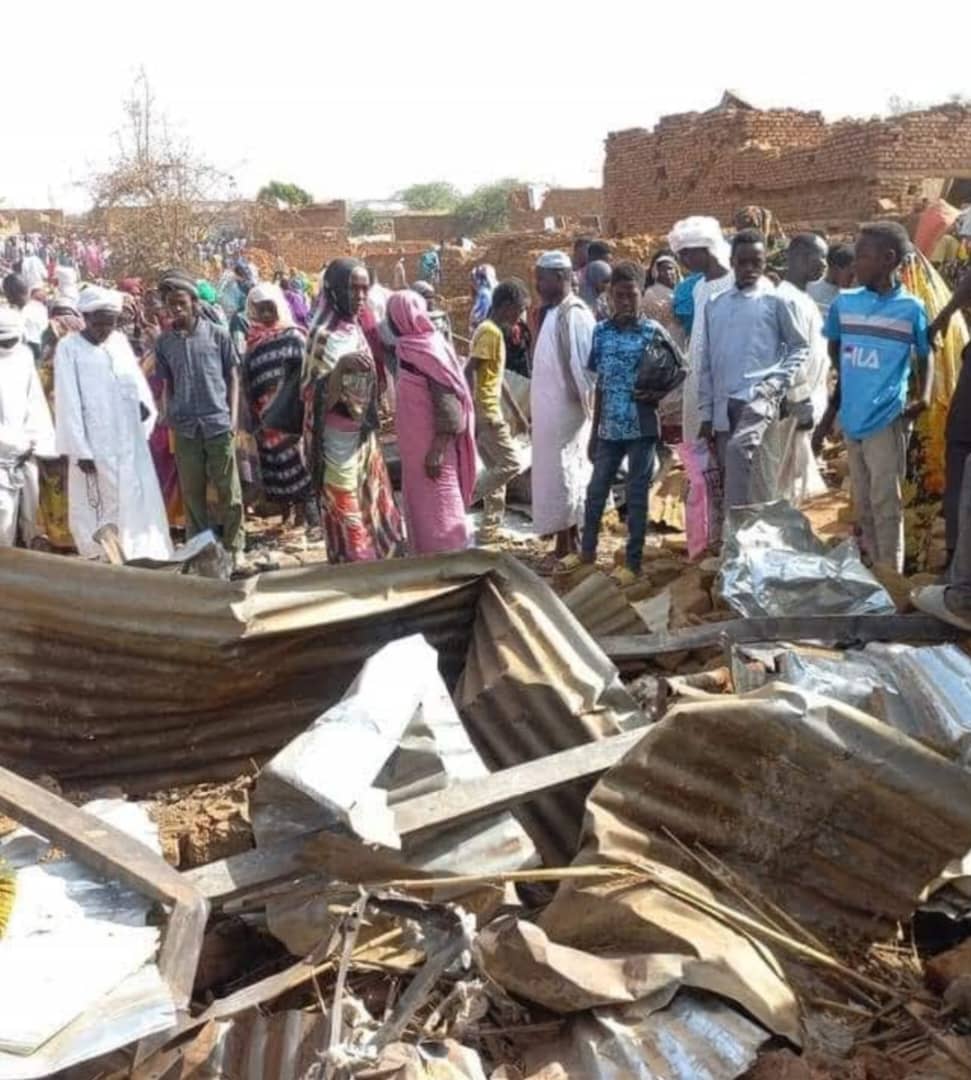
On January 25, a drone strike hit civilians gathered at a small internet café in Mellit locality, killing and injuring several people. Witnesses described scenes of panic, bodies scattered across the floor, and families desperately searching for missing relatives. No official explanation followed.

Similar incidents have been reported in South Kordofan, where a Christmas celebration was struck in late December 2025, and in other cases where schools, markets, hospitals, and displacement camps have come under attack despite being protected under international humanitarian law.
“These are not isolated accidents,” said a regional human rights monitor. “They reflect a pattern of conduct where civilian spaces are repeatedly exposed to military strikes.”
Turkish-Made Drones and Rising Civilian Harm
Multiple human rights organizations and conflict-monitoring groups have documented the use of Turkish-manufactured drones, including the Bayraktar TB2 and Akinci, reportedly operated by the Sudanese Armed Forces. The drones are produced by Baykar, a major Turkish defense company whose technology has been deployed in conflicts ranging from Ukraine to Libya.
Observers say drone deployment has correlated with a sharp increase in civilian deaths and the destruction of essential infrastructure. Already strained health facilities have been damaged or destroyed, leaving communities without access to medical care.
In under-resourced hospitals across Darfur, doctors work under extreme pressure, treating victims with severe burns, amputations, and shrapnel wounds. Medical staff report shortages of equipment, medicine, and blood supplies, while operating under constant fear of further strikes.
In some cases, bodies have been so badly mutilated that identification was impossible, forcing families to bury loved ones in mass graves.
Trauma in the Sky – Psychological Toll on Communities
Beyond physical devastation, the psychological impact of drone warfare has been profound especially on children.
Across Darfur and Kordofan, engine sounds now trigger panic, even when unrelated to military activity. A widely shared video shows a young child flattening himself to the ground to hide from a drone, before running in terror once it disappears. The clip has become a haunting symbol of the deep trauma being inflicted on an entire generation.
Families are also suffering long-term socio-economic consequences. Breadwinners killed in airstrikes leave households struggling to survive, pushing children into labor, early marriage, or displacement. Women increasingly shoulder the burden of supporting families in collapsing local economies.
Drones Target Livelihoods and Food Systems
Drone strikes have not only killed civilians they have systematically undermined livelihoods.
Human rights organizations report attacks on markets, crop storage centers, trade routes, livestock areas, grazing lands, and agricultural infrastructure. These strikes have disrupted agriculture and pastoralism, the backbone of survival in Darfur and Kordofan.
As food production collapses, prices have soared, worsening hunger and pushing once self-reliant communities into dependence on humanitarian aid. Even that aid is under threat: UN-backed humanitarian convoys have been attacked, restricting life-saving deliveries.
Sudan’s War Becomes a Regional Chessboard
While Sudan’s war began as a domestic power struggle, it has increasingly become a battleground for regional influence.
Among the most closely watched actors is Saudi Arabia, which has publicly supported peace efforts through international mediation initiatives, including the so-called Quartet. Yet analysts suggest Riyadh has also quietly aligned with Sudan’s military establishment to protect strategic interests.
Dr. Abdelkarim Al-Di, an East African political analyst, says Saudi Arabia faces a difficult balancing act.
“Saudi Arabia wants to preserve Sudan’s territorial unity, protect Red Sea trade routes, and prevent separatist movements,” he explained. “From Riyadh’s perspective, supporting centralized military authority appears more stable than allowing fragmentation.”
Observers argue that Saudi policy is largely pragmatic rather than ideological, shaped by concerns over security, Islamist movements, and regional rivalries.
A political analyst who requested anonymity said Riyadh’s strategy prioritizes state stability, even if it means tolerating controversial actors.
Turkey’s Role – Arms Sales or Political Alignment?
Turkey has also emerged as a central external actor, sparking debate over whether its involvement is purely commercial or strategically political.
Ankara officially frames its engagement as legal arms trade, with Sudanese military leaders purchasing drones through private channels. Turkey insists these transactions comply with international law.
However, analysts say the timing, logistics, and operational support tied to these drone deliveries suggest deeper involvement.
Dr. Yasser Abdelkarim, a political analyst, argues Turkey’s actions reflect a quiet alignment with Sudan’s military leadership.
“The military buys drones directly from Baykar, while official Turkish political support remains discreet but influential,” he said. “In war, arms are rarely neutral.”
Historical ties between Sudan and Turkey dating back to Ottoman administration have also shaped Ankara’s strategic understanding of Sudan’s military and social structure, enabling it to exert influence without overt military intervention.
Yet Turkey must navigate competing interests in Egypt, Libya, and North Africa, limiting how openly it can align with any Sudanese faction.
Accountability and the Search for Justice
As drone warfare intensifies, civilian protection has become a central global concern.
Human rights advocates argue that documentation is the foundation of accountability including medical records, witness testimony, photographs, strike data, satellite imagery, and physical evidence.
“This is not about revenge,” said a regional legal advocate. “It’s about building a credible record that can deter future abuses and support victims.”
Domestic accountability within Sudan remains limited, but international legal avenues exist, including:
The International Criminal Court (ICC), which retains jurisdiction over Darfur
The African Court on Human and Peoples’ Rights
UN human rights mechanisms
National courts using universal jurisdiction to prosecute war crimes
Targeting Arms Supply Chains
Another emerging strategy focuses on scrutinizing drone manufacturers and arms suppliers, including Baykar.
Legal experts suggest that international investigative journalism, consumer advocacy campaigns, and lawsuits in European courts could increase pressure on companies supplying weapons used in civilian-heavy conflict zones.
“Arms companies may claim neutrality,” said one analyst, “but when their products repeatedly kill civilians, the line between business and complicity becomes blurred.”
Media, Memory, and Breaking the Silence
Observers argue that media and digital advocacy will be critical in ensuring Sudan’s civilian suffering is not forgotten.
Campaigns using multilingual storytelling, survivor testimony, social media mobilization, and partnerships with international journalists could amplify victims’ voices and keep global attention on Darfur and Kordofan.
Survivors of drone strikes in Syria, Yemen, and Ukraine have also offered solidarity, building cross-border networks aimed at demanding accountability for civilian harm in modern warfare.
A Test for International Law and Global Conscience
For many Sudanese civilians, the question is no longer theoretical: Can international humanitarian law protect people when warfare moves to the sky?
The growing use of drones in Sudan has become a test case for global accountability, highlighting the tension between military technology, political interests, and human rights.
Experts warn that without sustained legal, diplomatic, and media pressure, drone warfare risks becoming normalized, leaving civilians in Darfur and Kordofan permanently exposed.
“Sudan’s war is no longer just a domestic conflict,” said one regional analyst. “It is a mirror of how modern warfare, foreign influence, and arms markets intersect often at the cost of civilian lives.”
For survivors, the hope remains that evidence, courage, and collective advocacy can transform suffering into justice.
The skies over Darfur and Kordofan remain dangerous. But victims and human rights defenders continue to document, speak, and resist silence determined that those lost to drone strikes will not vanish without accountability, memory, or meaning.