



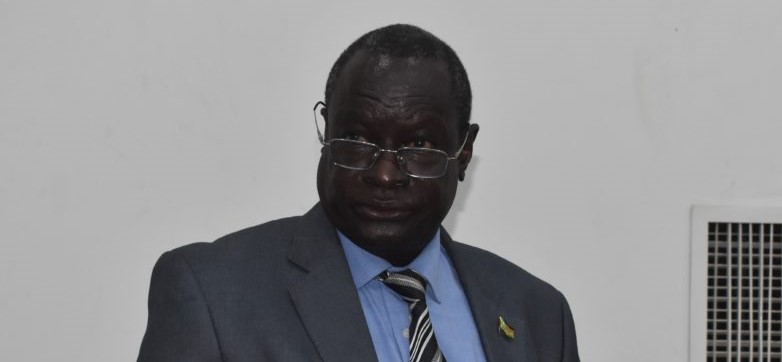
South Sudanese President Salva Kiir has dismissed Finance Minister Dr. Bak Barnaba Chol just over three months after appointing him, marking the ninth change in the post since 2020.
The South Sudan Broadcasting Corporation reported late Monday that Chol has been replaced by Salvatore Garang Mabiordit, who previously held the position from March 2018 to September 2020 and briefly from March to August 2023.
No official reason was provided for the latest reshuffle.
In the same series of presidential decrees, Kiir also relieved Monica Achol Abdel Aguek from her role as Presidential Envoy for Middle East Affairs (appointed November 2025), William Anyuon Kuol as Commissioner General of the South Sudan Revenue Authority (SSRA), and Moses Rou Ayii as Deputy Commissioner General.

They were replaced by Ambassador Muon Deng Ajuet and Solomon Ariik Manyok, respectively.
Economic and Governance Concerns
Policy analyst Boboya James Edimond said the frequent changes highlight deep structural weaknesses in economic management.
“Replacing officials alone will not fix structural problems,” Edimond said.
He linked the reshuffle to ongoing struggles with revenue mobilization, persistent salary arrears, and the government’s inability to meet basic obligations.
“The government has no money right now,” he added.
“They are looking for people who can bring in significant financial resources, but the crisis is not about individuals—it is about corruption, weak accountability, and poor public financial management.”
Edimond pointed out that while oil and non-oil revenues are generated, much of the money fails to reach the national treasury due to leakages, limiting public service delivery.
He argued that meaningful progress requires institutional reforms rather than “recycling officials.”
Calls for Female Leadership
The reshuffle comes amid renewed calls for gender diversity at the helm of the Finance Ministry.
In November 2025, civil society activist Angelina Adhel Malual, chairperson of the Civil Society Organization Network in Lakes State, urged Kiir to appoint a woman as finance minister.
“This ministry has been corrupted by men. Let it be given to us women so we can also look into it,” Adhel said at the time.
She cited persistent challenges—months of unpaid salaries, cash shortages in banks, and the sharp depreciation of the South Sudanese pound—that have left families struggling to afford basic needs.
Adhel argued that successive male ministers have failed to deliver accountability and effective financial stewardship since independence in 2011.
The latest leadership change occurs as South Sudan grapples with severe economic hardship, high inflation, currency depreciation, and a liquidity crisis, despite substantial oil revenues.