


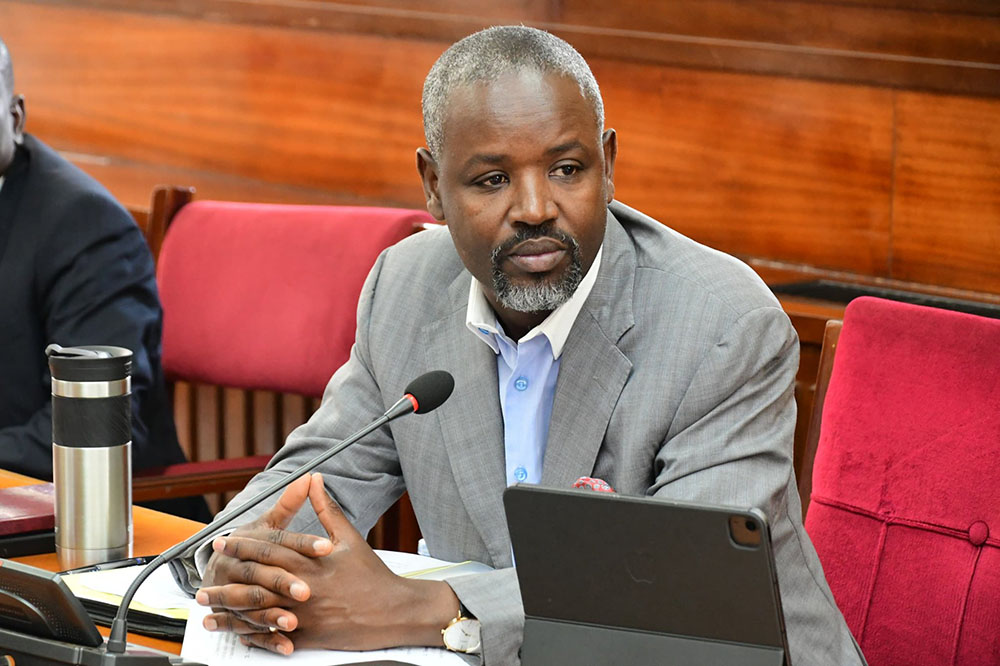
Deputy Speaker Thomas Tayebwa has pushed back against critics within the ruling National Resistance Movement (NRM) who have questioned his loyalty to the party, insisting his 15 years of service and repeated election victories demonstrate unwavering commitment.
Speaking to reporters shortly after meeting NRM leaders from Mubende District at his home in Kigo, Makindye Ssabagabo Municipality on March 4, Tayebwa addressed lingering doubts about his background as a former opposition member of the Forum for Democratic Change (FDC) before crossing to the NRM.
“Some people say, ‘But Tayebwa, you have just come from the opposition. How come you are guiding people to follow the party position?’” he said.
“I have been in NRM for 15 years. You want me to be a mugole for how long?”

Using a Luganda marriage metaphor, Tayebwa added: “If you have a wife for 15 years, do you still call her a mugole? Mwagala nsoke nobe? Do you want me to divorce the party first?”
He pointed to his electoral record in Ruhinda North County as proof of loyalty and political strength: elected unopposed in 2016, winning over 90 percent of the vote in 2021, and again facing no challenger in the 2026 polls.
“Three times delivering for the party, and you still call me mugole?” Tayebwa asked.
His remarks come at a sensitive moment in the NRM as internal debates intensify ahead of the election of parliamentary leadership in the incoming 12th Parliament.
President Yoweri Kaguta Museveni and the party’s Central Executive Committee (CEC) have endorsed incumbent Speaker Anita Among and Tayebwa to retain their positions when the new Parliament convenes.
Tayebwa defended his conduct as presiding officer, insisting he remains impartial while performing his constitutional role but cannot ignore the political realities that brought him to office.
“When I am in the Chair, I am neutral, that is my duty,” he said. “But I was sponsored by a certain party. Why else would the party struggle to sponsor me and the opposition struggle to sponsor theirs?”
He emphasised that decisions from the Chair must ultimately serve the national interest: “I ask myself: Does this facilitate government business or cripple it? Because when government business is crippled, it is not President Museveni who suffers, it is ordinary Ugandans.”
Under Article 82 of the 1995 Constitution, the Speaker and Deputy Speaker are elected by Members of Parliament and are expected to preside impartially.
Tayebwa urged NRM MPs to respect internal party positions, warning that public disagreements could weaken the party’s legislative agenda.
“For party members, I hope they follow the party position. There are many positions within Parliament and within the party,” he said.
He dismissed critics who argue parliamentary leadership should be determined solely by legal expertise: “Running a House is not just about being one of the best lawyers or a good debater.”
Tayebwa noted that parliamentary leaders often face public criticism regardless of their actions: “The same people praising former Speaker Jacob Oulanyah used to ridicule him. The same people attacked Rebecca Kadaga; now they are using her.”
He cautioned against chasing social media popularity: “If you want to be popular on social media, just grab a microphone, abuse the President, add his wife and son, then people will say you make sense. But if that is the script you want to bring into Parliament… I am sorry.”
Tayebwa advised that internal party disputes should be handled discreetly rather than through public confrontations: “The good thing is NRM has set a very good precedent on how we move. If one goes wrong, there are mechanisms to handle it. Once we go behind closed doors, we shall resolve this.”
He expressed confidence that, despite emerging rival ambitions, the ruling party would ultimately determine Parliament’s leadership: “I have a very strong conviction that it is NRM that is going to produce a Speaker and a Deputy Speaker.”
The incoming Parliament, expected to be sworn in around May 2026, will handle major legislative priorities including economic recovery, infrastructure investments, and public service reforms.