



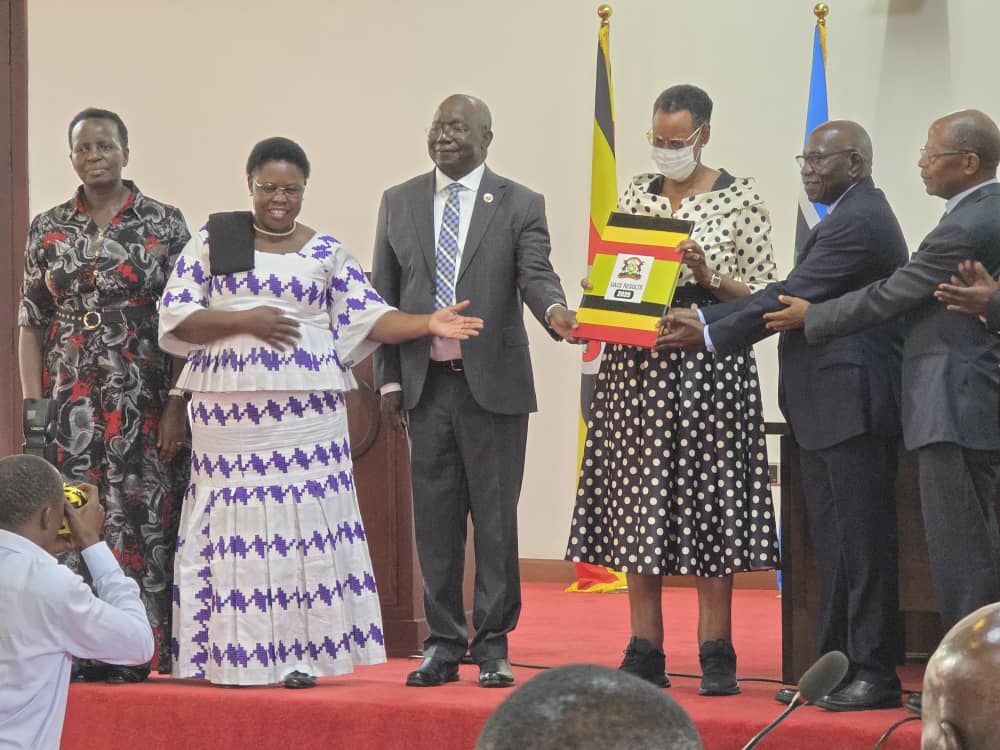
The 2025 Uganda Advanced Certificate of Education (UACE) results have been officially released by the Uganda National Examinations Board and the Ministry of Education and Sports at a ceremony held at State House Nakasero.
The release was presided over by the Minister of Education and Sports, Janet Kataaha Museveni, marking the conclusion of the 2025 national examination cycle at Advanced Level.
The examinations were conducted between November 10 and December 5, 2025, under the theme “Embracing security and holistic assessment of learners in a dynamic environment.”
The results indicate a general improvement in candidate performance, particularly in the number of students obtaining principal level passes. Out of 165,172 candidates who sat the examination, the vast majority attained the required grades to qualify for the UACE certificate.

According to statistics released by UNEB, 68,906 candidates representing 41.7 percent obtained three principal passes, while 44,385 candidates or 26.9 percent obtained two principal passes. Another 31,838 candidates, accounting for 19.3 percent, obtained one principal pass, while 18,152 candidates representing 11 percent obtained one subsidiary pass. Only 1,891 candidates, or 1.1 percent, failed the examination.
Overall, 163,171 candidates, representing 98.9 percent of those who sat the examination, qualified for the UACE certificate, which requires at least a subsidiary pass in a principal subject.
The results further show that 113,291 candidates, equivalent to 68.6 percent, obtained at least two principal passes and therefore qualify for admission to degree programmes if universities maintain the current minimum requirement. This is an increase from 92,273 candidates or 65.5 percent recorded in 2024. In addition, 145,129 candidates representing 87.9 percent obtained at least one principal pass and two subsidiary passes, making them eligible for diploma and other tertiary programmes including those offered in Technical and Vocational Education and Training institutions.
Although male candidates were more numerous, female candidates performed better proportionally across several pass levels. Among female candidates, 44.6 percent obtained three principal passes compared to 39.5 percent of males. A total of 72.8 percent of female candidates obtained at least two principal passes compared to 65.3 percent of males. Female candidates also recorded a lower failure rate of 0.8 percent compared to 1.4 percent among male candidates. Education officials say this reflects the continued positive impact of investments in girl-child education, although male candidates still dominate overall enrolment.
UNEB also reported improvements in several key subjects, particularly Mathematics, Chemistry, Agriculture, Geography and Economics. Science subjects recorded better performance compared to previous years, with Mathematics attracting 70,132 candidates in 2025, up from 58,495 in 2024. Entries also increased in other science subjects including Chemistry, which had 37,134 candidates, and Biology, which registered 35,660 candidates.
While humanities subjects continue to attract large numbers of candidates, examiners observed several challenges affecting performance. These include poor interpretation of examination questions, weak analytical skills and limited ability among candidates to relate theoretical knowledge to real-life situations. In subjects such as History, Religious Education and Geography, some candidates struggled with data analysis, logical presentation of arguments and linking fieldwork findings to practical geographical contexts.
Special interest groups also participated in the examination, including 540 candidates under Special Needs Education. Many of these candidates performed well, with a significant number obtaining three and two principal passes.Education programmes in correctional facilities also continued, with 68 inmates from Luzira Upper Prison sitting the examination. Thirty-one candidates representing 45.6 percent obtained three principal passes, while 66 inmates qualified for the UACE certificate, highlighting the role of education in rehabilitation.
The examination body also reported low levels of malpractice, with cases recorded in 47 out of 2,452 examination centres. A total of 351 candidates representing 0.2 percent of all candidates were implicated in cases involving possession of unauthorized materials, receiving assistance during science practical papers and impersonation. Their results have been withheld pending investigations.
Speaking at the release of the results, UNEB Executive Director Dan N. Odongo congratulated candidates who performed well and encouraged those whose results did not meet expectations to remain determined. He emphasized that education offers multiple opportunities and pathways and urged candidates to remain focused on their future goals.
Meanwhile, UNEB Board Chairperson Celestino Obua called for continued investment in science education, laboratories and teacher training to further improve performance in science and technology subjects. He also urged universities and other tertiary institutions to expand capacity to accommodate the increasing number of qualified candidates each year.