

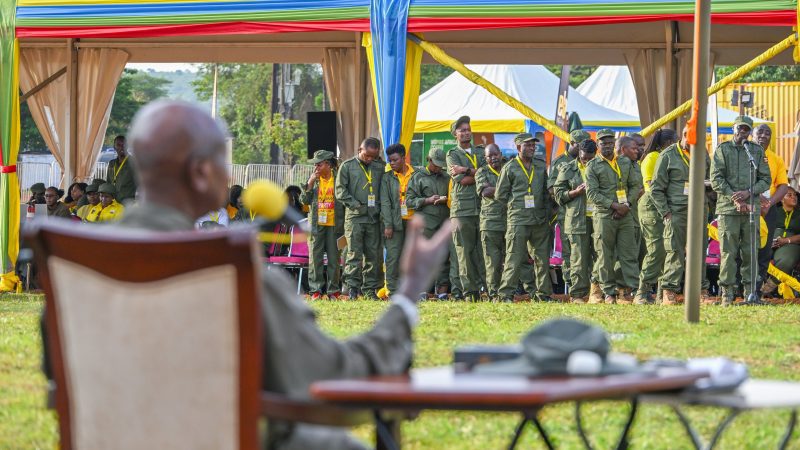

On Tuesday night, President Yoweri Kaguta Museveni engaged in a detailed discussion with journalists from the Lango sub-region at Baralegi State Lodge, while his campaign tour continued in the West Nile sub-region.
The conversation spanned national and regional issues, including the NRM’s accomplishments, Uganda’s long-term development plans, local concerns in Lango, and key national topics such as infrastructure and leadership succession.
President Museveni reaffirmed that the NRM remains the sole political party with a proven track record in maintaining peace, ensuring stability, and driving Uganda’s steady transformation. He highlighted the restoration of security, particularly the successful reduction of cattle rustling in Northern Uganda, as one of the party’s major achievements.
He also cited the NRM’s progress in expanding access to electricity, telecommunications, and education, calling these the foundation for sustainable development. “Job creation must be anchored in wealth creation,” Museveni stressed. “A strong economic base must come first before focusing on jobs.”

The President emphasized that Uganda must go beyond its domestic market by boosting regional and international trade. He credited NRM’s effectiveness to its clear ideology and its historic role in nation-building.
Museveni also noted that Uganda has reached middle-income status, with GDP projected to hit USD 66 billion by June 2026. He outlined ambitions to elevate the country to a high middle-income economy within five years, aiming for a USD 500 billion GDP, driven by agriculture, craftsmanship, manufacturing, services, and ICT.
On regional integration, he said the government will enhance economic relations with other African nations, promoting the East African Federation as a path to shared prosperity. “This plan will transform Uganda into a modern and thriving nation,” he assured.
Regarding local issues in Lango, Museveni identified subsistence farming and inadequate market-oriented planning as key challenges. He urged households to focus on both food production and income generation, recommending a four-acre model: one acre each for coffee, fruits, pasture, and food crops, complemented by backyard poultry, piggery, or fish farming in wetlands. He encouraged farmers to stay resilient despite fluctuating commodity prices.
On national matters, he addressed governance concerns, including Jimmy Akena’s disqualification, confirming the process was legal and not politically motivated. On succession, he highlighted that Uganda’s constitutional provisions clearly define leadership transitions, noting that the upcoming election with eight presidential candidates will determine the next president.
President Museveni also touched on infrastructure, stating that the Ministry of Works and Transport oversees road maintenance, with resources allocated according to national priorities. He additionally announced plans to restock water bodies with indigenous fish species, emphasizing support for local fish farmers while regulating lake fishing to avoid environmental damage.