

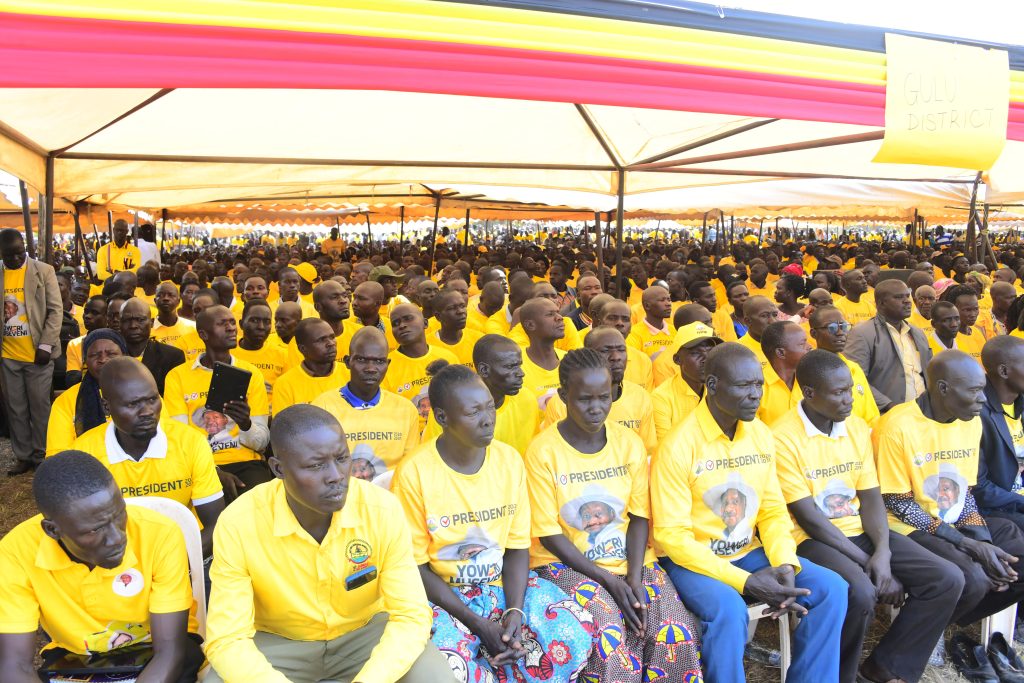
President Yoweri Kaguta Museveni has called on NRM leaders from Acholi and Adjumani to deliver a clear, unified message to their communities focusing on peace, wealth creation, and national development.
The President addressed the gathering of local leaders at Awich Primary Teachers’ College in Laroo Pece Division, Gulu City, on Friday, January 9, 2026.
He described the meeting as an opportunity to arm them with solid, practical responses to the questions ordinary Ugandans are asking about poverty, employment, and overall progress.
“I am giving you the right answers to share with the people you lead, because they keep wondering: How do we escape poverty? Where will jobs come from?” President Museveni stated.

He framed the session as part of the ongoing parish-level conferences and referenced a booklet he personally authored, which outlines the seven major contributions the NRM has made to Uganda over the last four decades.
The President identified peace as the NRM’s greatest achievement, attributing past national turmoil to divisive sectarian, tribal, and religious politics.
“By rejecting sectarianism and embracing patriotism and Pan-Africanism, we succeeded in building a truly national party and strong institutions, including a capable army and police force,” he explained.
He emphasized that lasting peace paved the way for national unity, increased production, surplus for sale, and integrated markets—contrasting sharply with the fragmentation seen in the 1960s.
Highlighting tangible development gains, President Museveni pointed to improved infrastructure across the region, including tarmac roads connecting Adjumani, Gulu, and beyond, widespread electricity extension, railway projects, and other major works.
On wealth creation, he strongly advocated for the four-acre farming model as an effective strategy for households with limited land. The approach recommends dedicating one acre to coffee, another to fruit trees, a third to pasture for dairy cattle, and the fourth to food crops for family use—supplemented by poultry, piggery (for non-Muslims), and fish farming near wetlands.
“If you implement these enterprises with proper planning and calculation—ekibaaro or cuura—you will never fail,” the President assured.
He also announced upcoming government initiatives to promote valley fishponds, referencing a successful pilot in Limoto as proof of concept.
Describing the NRM as a party rooted in enlightenment and truth-telling, President Museveni stressed the importance of modern farming techniques, including irrigation.
He cited government demonstration plantations in Bushenyi, where irrigation combined with fertiliser has boosted banana yields to as much as 53 tonnes per acre—significantly outperforming nearby farms.
Addressing livestock restocking in the north, the President acknowledged the severe impact of war and cattle rustling on herds in Acholi, Lango, and Teso.
Following consultations with affected communities, he said the government had agreed to provide cash compensation instead of in-kind livestock, with mechanisms now in place to facilitate restocking.
On job creation, President Museveni explained that the main sources of employment lie in commercial agriculture and industrialisation, urging leaders to communicate this message effectively to their people.
He further underscored regional integration as a key NRM legacy, warning against neglecting Africa’s enormous market potential.
“If we don’t focus on Africa and its market, what future awaits our grandchildren?” he questioned.
The President encouraged NRM leaders to lead by example, warning against staying in poverty (“chan chan”) and instead building prosperity (“lonyo”) in their own homes.
“It is unacceptable for leaders to remain poor. Every NRM leader should strive to prosper and demonstrate the path forward to the people,” he said.
To strengthen grassroots efforts, he pledged bicycles for LCI chairpersons to improve mobility, while LC III leaders will receive motorcycles.
NRM Vice Chairperson for Northern Uganda, Hamson Obua, reaffirmed the region’s strong backing for the President.
He noted that the campaign strategy has shifted toward intensive grassroots mobilisation and will employ a collective “factor tree” approach—where leaders work together to rally broad voter support for President Museveni and the NRM.