


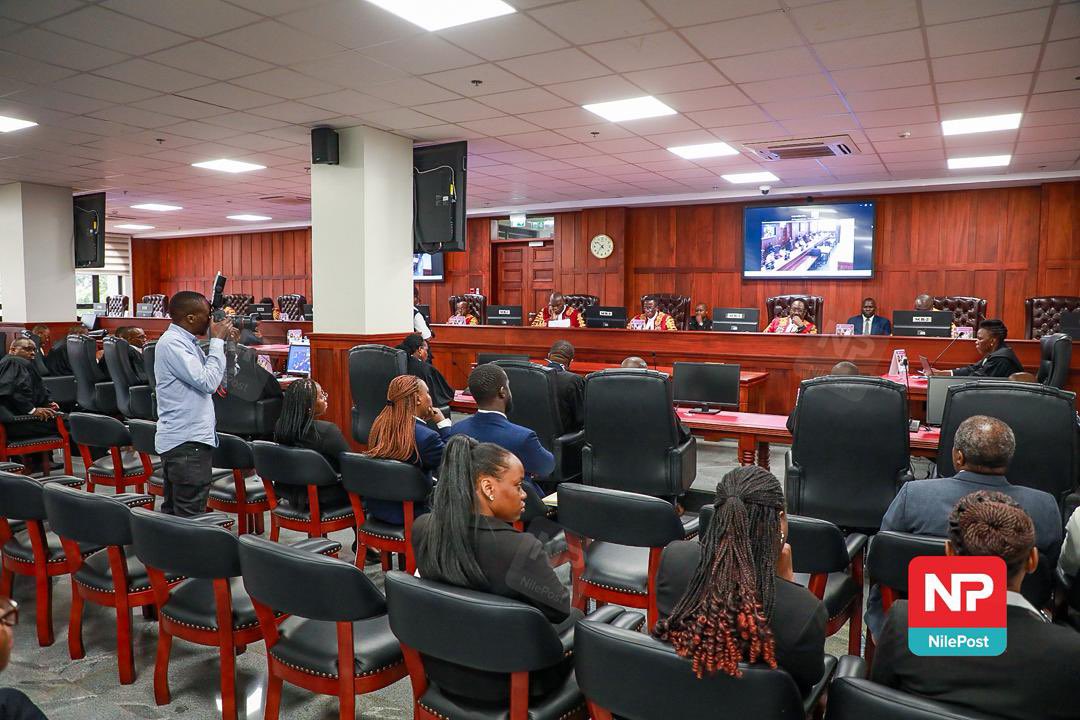
The Supreme Court of Uganda has granted former presidential candidate Robert Kasibante permission to withdraw his petition challenging President Yoweri Museveni’s victory in the January 15, 2026, presidential election.
The court ordered each party to bear its own costs and consequently affirmed Museveni as the legally elected President of Uganda.
The ruling brings to a close the only formal legal challenge to the 2026 presidential results at the apex court.
Uganda held its general elections on January 15, 2026, to choose the president and members of parliament. Four days later, on January 17, the Electoral Commission, chaired by Justice Simon Byabakama, declared longtime incumbent Yoweri Kaguta Museveni of the National Resistance Movement (NRM) the winner.

Official tallies showed Museveni securing 7,946,772 votes (71.65%). His closest rival, National Unity Platform (NUP) leader Robert Kyagulanyi Ssentamu (Bobi Wine), received 2,741,238 votes (24.72%).
Other candidates included Forum for Democratic Change’s Nathan Nandala Mafabi (209,039 votes), Democratic Party’s Gen. Gregory Mugisha Muntu (59,276), and several smaller-party aspirants.
Robert Kasibante, presidential candidate of the National Peasants Party (NPP), polled just 33,440 votes (0.30%), placing him near the bottom of the eight-candidate field.
On January 18, 2026 — the day after the results were gazetted — Kasibante filed Presidential Election Petition No. 1 of 2026 at the Supreme Court. He named Museveni, the Electoral Commission, and the Attorney General as respondents.
The petition alleged widespread irregularities, non-compliance with the Presidential Elections Act, and electoral malpractices.
Kasibante sought nullification of the results and, in some statements, suggested the true winner was Bobi Wine. He also filed a separate application demanding wide-ranging discovery and an audit of biometric voter verification records, scanners, servers, and all election returns.
The Supreme Court began inter-partes hearing of the main petition on February 3, 2026, with a full bench of justices. Proceedings included written submissions and arguments on the discovery application.
On February 5–6, 2026, Kasibante abruptly changed course.
Through his lawyers, he filed a Notice of Motion seeking leave to withdraw both the substantive petition and the discovery application.
In interviews and court documents, the NPP leader cited “prohibitive costs” — estimating the full prosecution would require approximately $5 million — which neither he nor his party could afford.
He added that political parties and individuals who had pledged financial and logistical support failed to deliver, forcing him to abandon the case.
The respondents (Museveni’s legal team, the Electoral Commission, and the Attorney General) did not oppose the withdrawal itself but had earlier indicated they would seek costs.
Delivering the decision this morning, the Supreme Court allowed the withdrawal in full.
By ordering each party to bear its own costs, the justices avoided imposing any financial penalty on Kasibante. The effect of the ruling is the automatic dismissal of the petition and the affirmation of Museveni’s election victory.
With no other presidential election petitions before the court, President Museveni’s re-election now stands unchallenged in law.
Kasibante, who has not issued a fresh statement since the ruling, had earlier described the withdrawal as a “Plan B” necessitated by financial reality rather than any change in his belief about the election.