






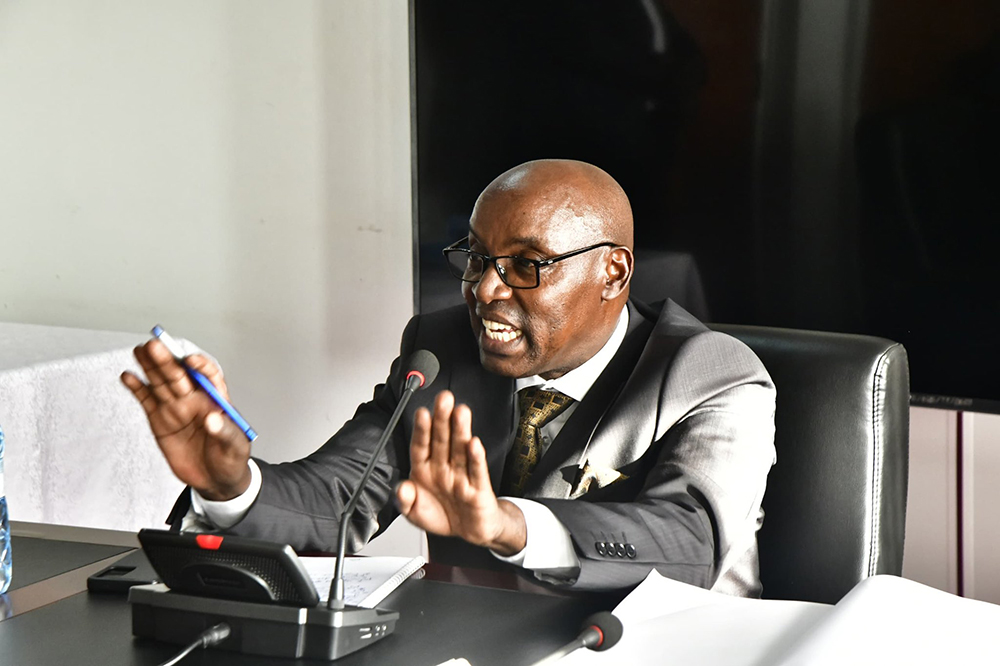
The Judiciary has formally presented its funding requirements for the 2026/2027 financial year, requesting significantly higher allocations to address rising operational demands, expand court infrastructure, and clear a growing backlog of cases.
The request was made during a high-level engagement at the Court of Appeal building in Kampala between the Judiciary’s top management, led by Chief Justice Dr. Flavian Zeija, and Minister of State for Finance, Planning and Economic Development (General Duties) Henry Musasizi.
Discussions centred on budget constraints, resource prioritisation, and strategies to ensure smooth operations and compliance with statutory obligations.
Justice Zeija expressed appreciation for the government’s continued support, noting the Judiciary’s budget had grown from UGX 199 billion in FY 2020/2021 to UGX 442 billion in FY 2025/2026.

“This is my first engagement with the Minister since assuming office, and I take this opportunity to thank the government for the enhancement of our budget over the years,” Zeija said.
Despite the increase, he stressed that the current allocation represents only 0.61 percent of the national budget and 43 percent of Parliament’s funding — levels insufficient to match court expansion, judicial staffing growth, and the surging caseload.
Citing the National Court Case Census 2025, the Chief Justice revealed thousands of pending high-value cases, including:
- 5,790 commercial cases worth UGX 5.981 trillion
- 44,911 civil cases valued at UGX 5.451 trillion
- 33,496 land cases amounting to UGX 1.718 trillion
- 12,624 family cases totalling UGX 1.47 trillion
“Delays in resolving these matters directly affect investment and productivity,” Zeija said.
“The Judiciary is not a mere consumer of resources; it is a catalyst for economic growth. Timely and predictable justice builds investor confidence, while prolonged disputes discourage economic activity.”
The Chief Justice outlined short- to medium-term reform priorities requiring budgetary support, including:
- Operationalisation of all High Court Circuits
- Decentralisation of the Court of Appeal to eight regions
- Strengthened case management and rollout of Alternative Dispute Resolution (ADR)
- Advancements in ICT, such as the Electronic Court Case Management Information System, AI-assisted transcription, and virtual hearings
- Establishment of a delivery unit and real-time situational room
Long-term plans include a fully paperless Judiciary, permanent regional appellate infrastructure, an African ADR Centre, expanded judicial staffing, procedural modernisation, and data-driven performance management.
Justice Zeija highlighted recent institutional growth: eight Court of Appeal Justices, 21 High Court Judges, and 82 lower bench judicial officers appointed in the past two financial years, with High Court circuits increasing from 24 to 29.
Case registrations have risen sharply from 317,929 in FY 2020/2021 to 450,134 in FY 2024/2025 — a 41.58 percent increase.
He reiterated the need for enhanced funding to ensure timely justice, strengthen public confidence, and position the Judiciary as a driver of economic development.
The Chief Justice also prioritised election petitions, high-value matters, judicial welfare, and zero tolerance to corruption.
Minister Musasizi and his team are expected to consider the proposals as part of the national budgeting process for FY 2026/2027.