Minister of Justice Norbert Mao has reaffirmed Uganda’s unwavering support for the International Criminal Court (ICC), despite increasing global criticism and attacks directed at the institution, its judges, and its officials.
During a high-level engagement on December 2, 2025, at the World Forum in The Hague, Mao met with ICC President Judge Tomoko Akane on the sidelines of the 24th Assembly of States Parties (ASP). The meeting underscored Uganda’s long-standing commitment to international justice and the ICC’s mandate.
Also present were several senior Ugandan diplomats and judicial officials, including ICC Judge Salome Bbosa and Ambassadors Mirjam Blaak, Duncan Muhumuza, and Beatrice Pacunega Manano—reflecting the close coordination between Uganda’s diplomatic and judicial institutions.
Discussions between Mao and Judge Akane centered on the recent wave of international attacks on the ICC, including sanctions imposed on some of its judges and staff. Mao expressed deep concern over these developments but emphasized that Uganda remains firmly behind the Court and its efforts to uphold global justice and the rule of law.

Quoting a proverb, Mao said, “It is the water in the boat that causes a boat to sink, not the waters outside,” encouraging the ICC to maintain internal unity and resilience in the face of external pressure.
Judge Akane thanked Uganda for its consistent support, acknowledging the country’s role in strengthening the Court’s work even in challenging times.
Mao also held talks with Deputy Prosecutor Mame Mandiaye Niang, where they reaffirmed the strong relationship between Uganda and the ICC. He highlighted that Uganda was the first country to refer a case to the Court and continues to play an active role within its Bureau.
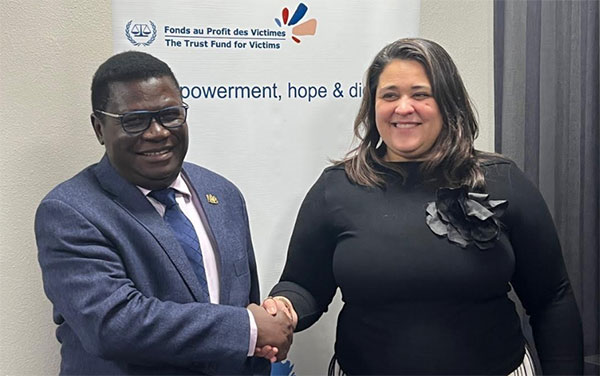
In a separate meeting with Dr. Deborah Ruiz Verduzco, the ICC’s Director of the Trust Fund for Victims, Mao discussed progress on implementing the €52 million reparations award in the Dominic Ongwen case. Their discussions focused on resource mobilization and effective strategies for delivering the reparations.
The ASP, which opened on December 1 and runs until December 6 at The Hague, continues to highlight Uganda’s influential role in supporting international justice mechanisms. It also brings into focus the challenges the ICC faces as it strives to uphold fair and impartial justice amid rising global hostility and threats to multilateralism.
As the Assembly proceeds, ongoing dialogue between State Parties and the ICC remains essential in safeguarding the Court’s mission and preserving the rules-based international order.