






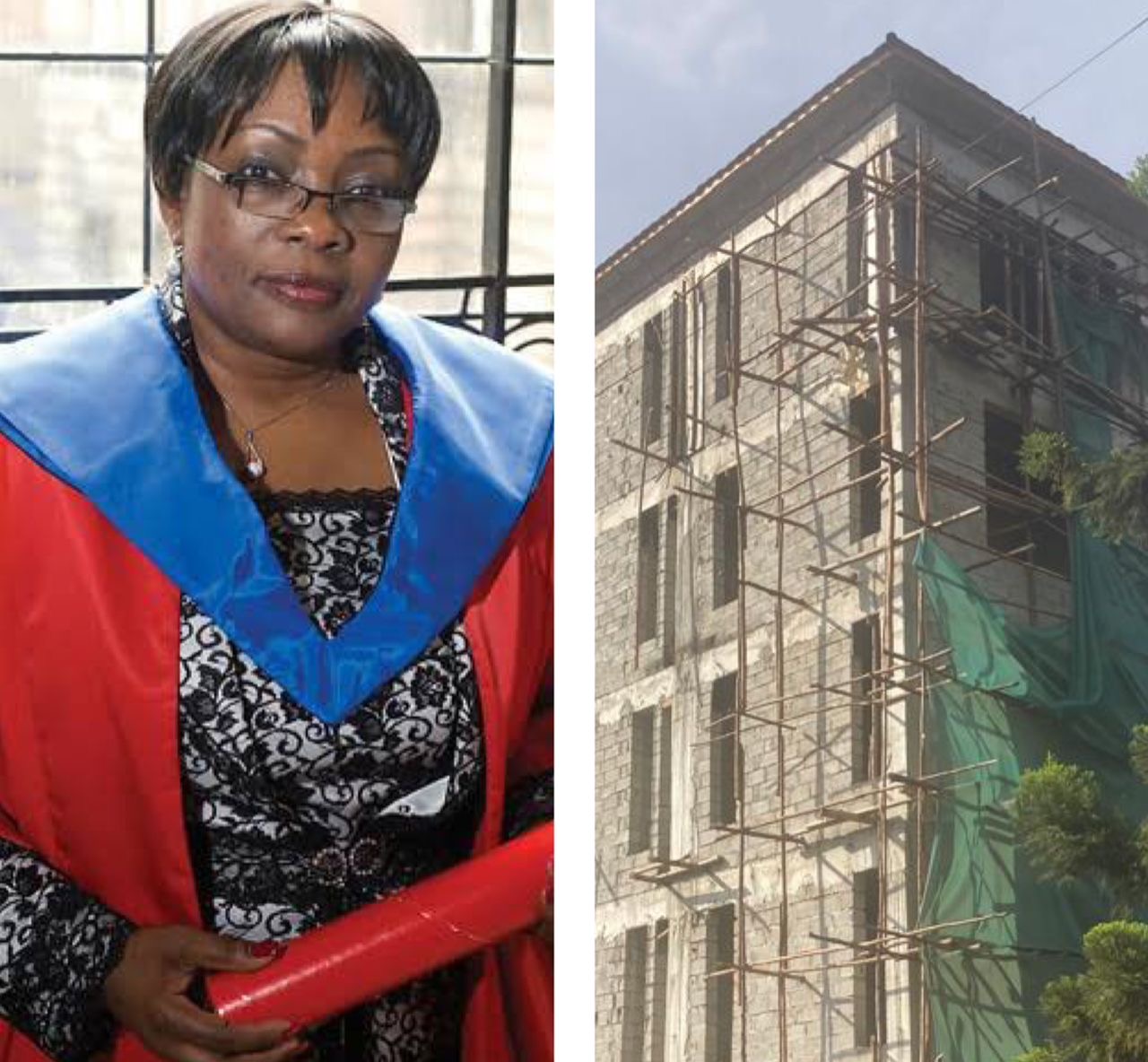
The legal troubles surrounding a contested apartment project in Bugolobi have intensified after the High Court dismissed an application seeking to halt criminal proceedings linked to the development, even as an earlier court order had already stopped further construction on the property.
In a ruling delivered on April 14, 2026, Justice Alex Mackay Ajiji dismissed a criminal revision application filed by John Ssebutinde the husband of Julia Sebutinde, the judge of the International Court of Justice (ICJ) effectively clearing the way for a private prosecution to proceed before the Magistrates Court.
The criminal case stems from allegations of failure to comply with a lawful order to stop construction at Plot 8, Princess Anne Drive in Bugolobi, where a multi-storey apartment block owned by Judge Sebutinde and her husband has been under scrutiny from residents and local authorities.
Attempt to Block Prosecution Fails

In his application, John Ssebutinde had asked the High Court to revise and dismiss the criminal proceedings, arguing that the charges were defective, the private prosecution was improperly instituted, and that the transfer of the case from Nakawa to Buganda Road Court was irregular.
However, Justice Ajiji rejected all grounds, ruling that the application was premature and legally untenable, since the accused persons had not yet taken plea before the trial court.
The judge emphasized that the High Court’s revision powers apply only to final decisions, not ongoing criminal proceedings.
“Only a final order can be the subject of revision,” the court ruled, adding that interlocutory decisions cannot be challenged through such applications.
The court further observed that many of the issues raised including the validity of the charge sheet and the legality of the private prosecution, are matters that must be addressed during the trial itself, not avoided through pre-trial applications.
In a pointed remark, Justice Ajiji warned against attempts by accused persons to use legal technicalities to evade trial, noting that the applicants had repeatedly failed to appear in court despite summons.
The application was consequently dismissed, with the court directing that the criminal case be fast-tracked and concluded expeditiously.
Court Previously Halted Construction
The latest ruling adds to an earlier decision by the High Court which had already halted further construction on the same property following complaints from residents.
In January 2026, in Miscellaneous Application No. 1106 of 2025 arising from Civil Suit No. 470 of 2025, the court granted a temporary injunction stopping all building works at the Bugolobi site.
The order followed an application by neighboring residents, who challenged the legality of the multi-storey apartment project, arguing that it violated applicable building laws and disrupted the residential character of the area.
In that ruling, the court found that the case raised serious triable issues, including whether the developers had obtained the necessary approvals under the law.
The court further held that residents were likely to suffer irreparable harm, citing complaints of noise, dust, invasion of privacy, and continuous construction activities.
As a result, the court ordered that the status quo be maintained, effectively stopping any further construction for an initial period of six months, pending determination of the main suit.
Legal Battle on Two Fronts
With both civil and criminal proceedings now active, the Bugolobi apartment dispute has evolved into a complex legal battle involving residents, city authorities, and the developers.
The civil case seeks to determine the legality of the construction itself, while the criminal proceedings focus on alleged defiance of a stop order issued by Kampala Capital City Authority (KCCA).
The High Court’s latest ruling ensures that the criminal case will proceed, where issues such as compliance with building regulations, the validity of approvals, and responsibility for the construction will be tested through a full trial.